
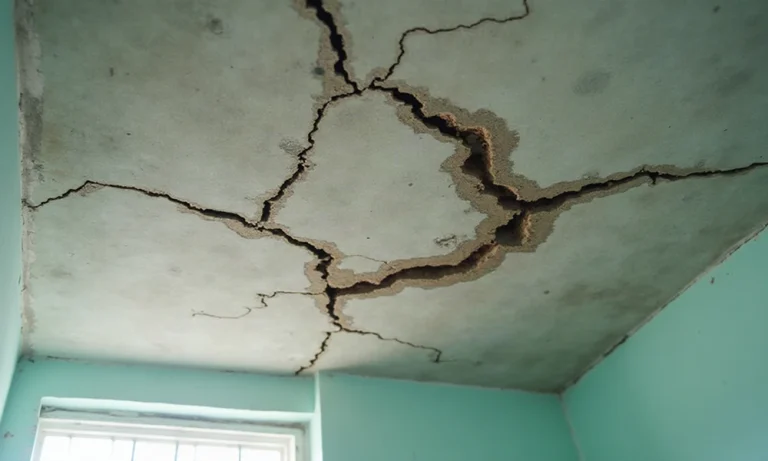
Spalling concrete, the cracked, bulging patches that eventually drop chunks of concrete from a ceiling, is largely caused by carbonation, a slow chemical process that corrodes the steel reinforcement bars sitting just beneath the surface. It’s especially common in older buildings and in damp, humid rooms like kitchens and bathrooms, because moisture and carbon dioxide reaching those bars through cracks or old drill holes is what keeps the corrosion going. That detail, moisture feeding the process, is the part a straightforward concrete patch doesn’t actually deal with.
Repair of a Spalling Concrete Ceiling Only Fixes What’s Already Visible
A repair spalling concrete ceiling job, done properly, removes the damaged concrete, cleans and treats the exposed rebar for rust, applies a bonding agent, and patches the area with cement mortar before repainting. That process addresses the damage that’s already happened. It doesn’t do anything about whatever has been feeding moisture to that spot in the first place, which means the same corrosion process can simply resume underneath a brand new patch if the source of the moisture was never identified.
This is why a patch that looks perfectly finished on handover day can bulge and crack again within a year or two, not because the repair itself was done badly, but because it was only ever treating the visible half of the problem.
Carbonation Needs Moisture to Keep Spreading, and Moisture Needs a Way In
Humidity in the air speeds up carbonation on its own, but a steady, localised source, a leaking pipe above, a bathroom floor that was never properly sealed, water tracking along a crack from the unit upstairs, accelerates it dramatically in one specific spot. That’s usually why spalling shows up as isolated patches rather than evenly across an entire ceiling: the corrosion is following wherever the water has actually been getting through.
Three Signs the Real Problem Is Above the Ceiling, Not In It
- The spalling patch sits directly below a bathroom, kitchen, or balcony floor in the unit above
- A patched area returns within a year or two, in the same spot or just beside the original repair
- There’s any staining, discolouration, or dampness around the spalled area, not just the crumbling concrete itself
Why Waterproofing Contractors in Singapore Get Called After the Concrete Contractor, Not Before
Many homeowners only start looking for waterproofing contractors in Singapore once a spalling repair has already failed a second time, by which point the moisture source has usually had years to establish itself. Bringing in a waterproofing assessment before or alongside the concrete repair, rather than after it fails again, means the actual leak path gets sealed at the same time the visible damage gets patched, so the two jobs reinforce each other instead of one quietly undoing the other.
Does Every Spalling Repair Actually Need a Waterproofing Check Too?
Not every case. A spalling patch in a dry, well-ventilated area with no wet room directly above it may simply be the result of ordinary ageing and humidity, and a standard repair can be the end of it. The cases worth flagging for a waterproofing check are the ones with a wet room overhead, a history of repeat spalling in the same spot, or visible staining alongside the damage, since those are the patterns that usually point to an active moisture source rather than general wear.
Age of the building matters here too, though it isn’t the whole story on its own. Older flats naturally carry more risk simply because carbonation has had more decades to work on the reinforcement, and older waterproofing membranes in the units above have had more time to degrade or crack. A newer building isn’t automatically immune; a poorly sealed bathroom floor can start leaking within a few years of completion, but when a spalling patch does show up in an older block, it’s worth treating the wet-room-above pattern as the more likely explanation rather than the exception.
None of this means every ceiling crack is secretly a waterproofing emergency. It means the two trades are solving connected problems, and treating them as connected from the start tends to be the difference between a repair that lasts and one that’s due to be redone in a year or two.
Checking whether a spalling patch is hiding a waterproofing issue takes one inspection, not a guess. Contact General Waterproofing & Service to arrange an assessment before booking just the concrete repair.