
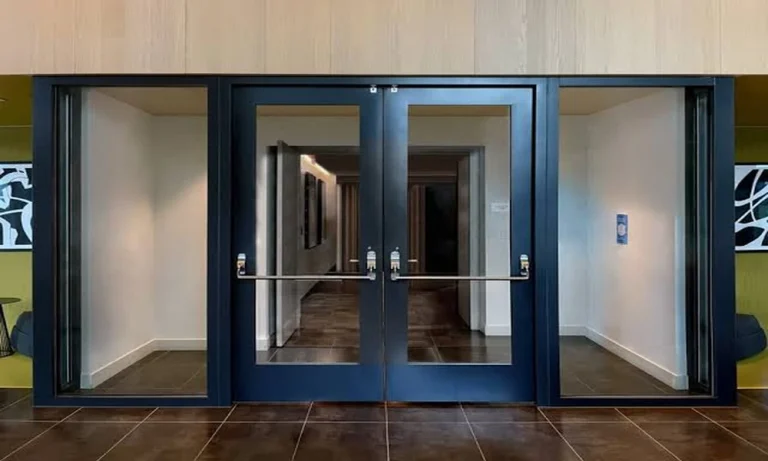
Fire doors are often treated as ordinary doors with a special label. In practice, a fire rated door singapore is a tested assembly designed to hold back fire and smoke for a defined period, protecting escape routes and giving occupants time to leave a building. Whether it does that job depends on the rating, the components, the installation and how the door is maintained. Understanding fire resistance requirements helps building owners, contractors and facility managers specify the right doors and keep them compliant over time.
What Fire Resistance Means
Fire resistance describes how long a building element can perform its fire-separating function under test conditions. For doors, two criteria are usually considered: integrity, meaning the door prevents flames and hot gases from passing through, and insulation, meaning it limits the temperature rise on the unexposed side. Ratings are expressed in time, such as half an hour, one hour or two hours, and reflect performance in a standard furnace test rather than any particular real fire. A higher rating is not automatically better for every location, since heavier doors are harder to use and cost more.
Where Requirements Come From
In Singapore, fire safety requirements for buildings are set out in the Code of Practice for Fire Precautions in Buildings, commonly called the Fire Code, issued by the Singapore Civil Defence Force. The Fire Code specifies where fire-rated doors are needed, such as in compartment walls, protected staircases and fire lobbies, and the minimum rating for each location. Fire doors must also be listed under the SCDF’s Product Listing Scheme, which requires certification by an accredited certification body.
How Fire Doors Are Tested
Fire doors are tested as complete assemblies, not just door leaves. Testing to standards such as BS 476 Part 22 or EN 1634-1 places the door, frame and hardware in a furnace and measures how long it maintains integrity and, where relevant, insulation. The certification applies to the tested configuration. Changing the frame, ironmongery, glazing or seals without approval can invalidate the rating, even if the door leaf itself is unchanged. This is why replacing a lock or adding a kick plate should always be checked against the door’s certification first.
Key Components of a Fire Door
Every part of the assembly plays a role. A compliant door set typically includes:
- A door leaf with a fire-resistant core
- A matching certified frame
- Intumescent seals that expand in heat to close gaps
- Smoke seals where smoke control is required
- Certified hinges, locks and self-closing devices
- Fire-rated glazing if vision panels are fitted
Each component should be compatible with the tested design.
Self-Closing and Hold-Open Devices
A fire door only works when it is closed. Most fire doors must be fitted with a self-closing device that returns the door to the closed and latched position. Propping doors open with wedges is a common and dangerous breach. Where doors need to stay open for traffic, the Fire Code allows hold-open devices that release automatically when the fire alarm activates, closing the door during a fire. These must be properly connected and tested regularly.
Gaps, Seals and Installation
Even a well-made door can fail if installed poorly, which is why anyone sourcing a fire rated door singapore supplier should ask who will fit it. Gaps between the leaf and frame must be within specified tolerances, as large gaps allow fire and smoke to pass. Intumescent and smoke seals must be continuous and undamaged. The frame must be fixed securely to the wall, and the gap between frame and wall filled with appropriate fire-stopping material. Installation should be carried out by trained installers following the manufacturer’s instructions.
Labelling and Documentation
Fire doors in Singapore usually carry a label or mark identifying the product and its certification. This allows inspectors to confirm that a door is a listed product with the correct rating. Building owners should keep documentation including:
This documentation supports fire certificate applications and inspections.
Ongoing Maintenance
Fire doors are used daily, and wear can quickly compromise them. Hinges loosen, closers weaken, seals get damaged and doors are sometimes modified without considering fire performance. Regular inspection should check that doors close and latch fully, seals are intact, gaps are within tolerance and no unapproved modifications have been made. Damaged components should be replaced with compatible, certified parts. Keeping a register of every fire door, with its location, rating and last inspection date, makes this work much easier to manage across a large building.
Choosing the Right Supplier
Specifying fire doors requires attention to the rating, certification, components and installation. Work with suppliers who can provide listed products, supporting documentation and installation by trained teams. Your qualified person or fire safety engineer will confirm the ratings needed for each location. A specialist in certified fire door supply and installation can help ensure that what is installed matches what was approved.
A Simple Daily Test
Open any fire door in your building and let it go. If it does not close and latch on its own, it is not doing its job, and it should be repaired before anything else.