
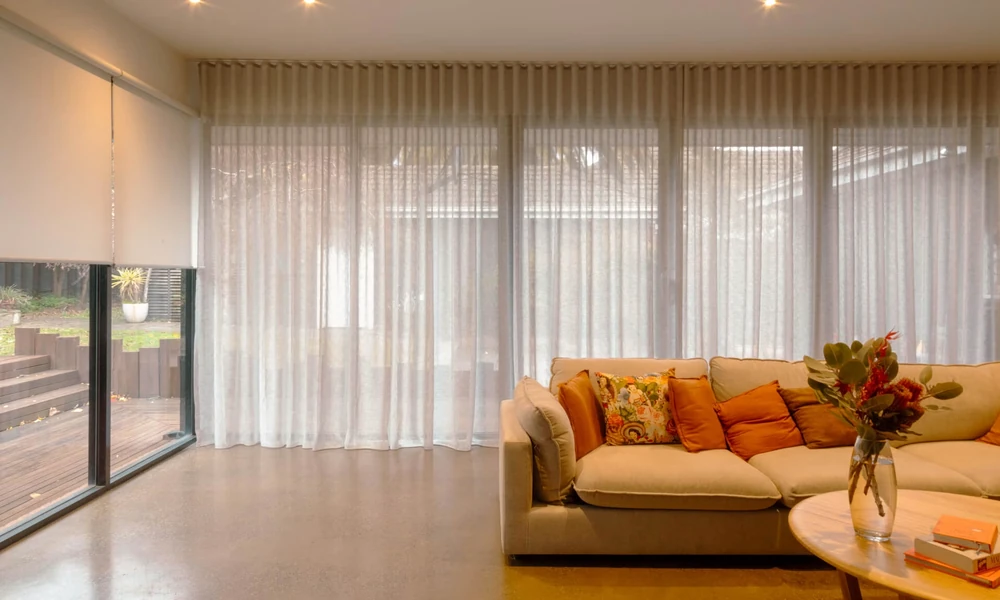
Look at almost any recently completed condominium interior and the curtains will hang in smooth, evenly spaced waves rather than gathered pleats. The heading has no visible pinches, the folds run continuously from track to floor, and the whole thing reads as a single soft plane. S fold curtains achieve that look through a different heading system, and the popularity is as much about how they behave as how they appear.
What Makes the Fold
Conventional pleated curtains are gathered into fixed pinches at the top, sewn in place, with fabric bunching between them. An S fold uses a track with evenly spaced carriers and a tape with regularly positioned loops or snap connections, so the fabric is held at fixed intervals and falls naturally into a continuous wave. Nothing is sewn into a pleat, which is why the fold appears to run uninterrupted from the heading to the hem.
The Visual Argument
The result is cleaner and more contemporary than pinch or pencil pleats, with no decorative heading competing for attention. Because the folds are uniform, the eye reads a rhythm rather than a series of gathered points, which suits minimal interiors and large expanses of glass. It also emphasises height, since the vertical wave runs unbroken, which is useful in apartments where ceiling height is modest and every visual trick helps.
They Stack Back Neatly
The practical advantage most homeowners notice is the stack. Because the fabric is held in a consistent wave, it concertinas predictably when drawn open and occupies a narrower stack than gathered headings of the same fullness. In apartments where window walls extend nearly the full width of a room, a tidy stack means less glass obscured when the curtains are open, which is a real gain in both light and view.
Fabric Weight and Drape
The wave depends on the fabric hanging properly, so drape matters more than pattern. Medium-weight fabrics with good fall work best. Very stiff fabrics resist the curve and produce angular folds rather than smooth ones; very light sheers can work but need the correct fullness to hold shape. When choosing, hold a length of fabric and let it fall rather than judging from a flat swatch on a table, because how a fabric behaves hanging is the whole point of this heading.
Fullness Determines Whether It Looks Right
The wave depth is set by the ratio between fabric width and track length, and by the spacing of the carriers. Too little fullness and the folds flatten into a limp panel; too much and they crowd and lose definition. A properly specified S fold curtain system gets this ratio right for the chosen fabric weight. It is the specification most often trimmed to reduce a quotation, and the one that most visibly determines whether the finished result looks like the reference photograph.
Track Quality Is Not Optional
This heading depends entirely on the track. Carriers must be evenly spaced and run smoothly, and the track must be straight and rigid enough not to sag across a wide span. A cheap track produces uneven wave spacing, sticking carriers and a curtain that jams halfway. Because the track is doing structural and aesthetic work simultaneously, it is the wrong place to save money, particularly on the long runs common in modern apartments.
Motorisation Suits Them Well
Smooth, low-friction tracks make S fold curtains natural candidates for motorisation, and on tall or wide installations that convenience is significant. Motorised systems also open and close consistently, which preserves the fold spacing over time. If motorisation is a possibility later, run the wiring or plan the power point during the fit-out rather than retrofitting it afterwards, when the solution usually involves visible trunking.
Layering With Sheers and Blockout
The typical arrangement uses a sheer S fold on the window side for daytime privacy and diffused light, with a blockout or heavier fabric on the room side for night. Both layers can use the same heading, which keeps the appearance consistent. This requires a double track and a deeper curtain box or reveal, so it is worth deciding early, since retrofitting a second track into a shallow recess is frequently not possible.
How They Compare on Cost
S fold curtains generally sit above pencil pleat and around or slightly above pinch pleat, and the difference is in the track rather than the sewing. A quality track with correctly spaced carriers costs meaningfully more than a basic curtain rail, and the heading requires generous fullness to look right, so there is more fabric in the finished product. Against that, there is no elaborate hand-sewn heading, and the fabric stacks tightly enough that some rooms need a shorter track than they would otherwise. Ask for quotations broken into fabric, making, track and installation, since that is where the differences between suppliers actually sit.
Living With Them
Practical considerations are straightforward. The heading tape and carriers should be checked occasionally, since a detached connection breaks the wave visibly. Cleaning follows the fabric’s requirements, and most quality curtains benefit from professional cleaning rather than domestic washing. Handle them by the fabric body rather than pulling at the leading edge, or use a wand. Specified with the right fullness, a good track and a fabric that drapes, S fold curtains look considered rather than merely fashionable, and they continue to hang correctly years after installation.

Comments are closed.