
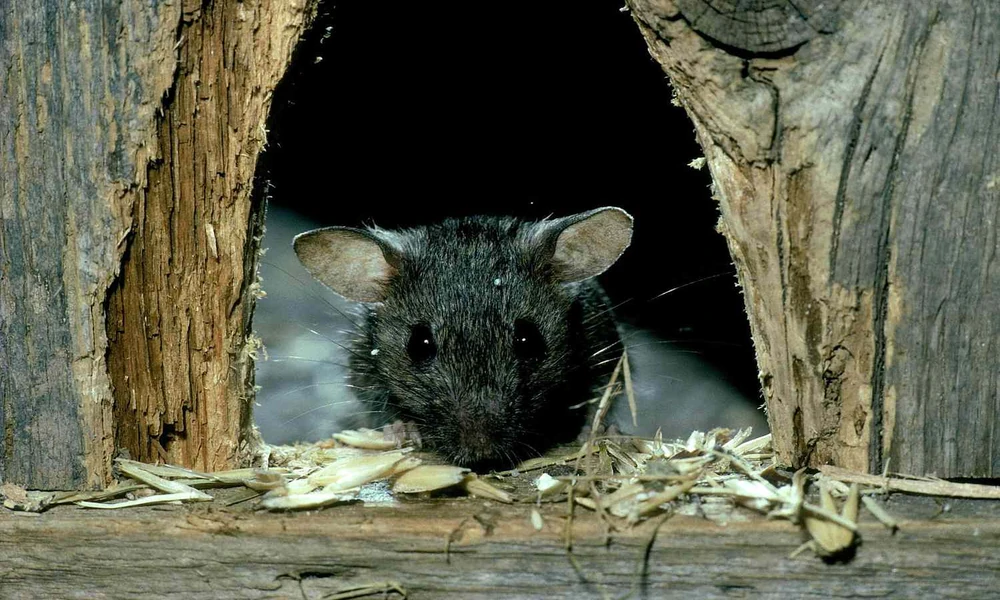
A mouse in the garage in October doesn’t surprise many Missouri homeowners. Mice living inside the walls are a bigger problem. Zip Zap Pest, a Lawson company led by a Board-Certified Entomologist, handles rodent calls across the Northland every fall and winter. Very often the homeowner thought the mice had stayed in the garage. Here are nine signs they’ve moved into the house, followed by five local companies that handle rodent control.
In Missouri homes, the house mouse is the most common culprit. Deer mice sometimes get in too, especially in rural properties and outbuildings. According to the Centers for Disease Control and Prevention (CDC), mice can squeeze through openings about the size of a dime. Attached garages give them an easy route into wall cavities, ceilings and crawl spaces.
How do you know if mice are living in your walls?
1. Do you hear scratching at night?
Scratching, scurrying or light tapping inside walls or ceilings is often the first sign. Mice are most active from dusk to dawn, so the sounds usually start after the house gets quiet. Squirrels and other larger animals tend to make heavier thumping noises, and they are usually more active during the day.
2. Are you finding droppings indoors?
Droppings are the clearest evidence of mice. Mouse droppings are about 1/8 to 1/4 inch long, dark and pointed at the ends, a little like grains of rice. Check these areas:
- inside kitchen cabinets
- in drawers
- behind the refrigerator and stove
- under sinks
- along the back edges of pantry shelves
Fresh droppings are dark and soft. Older ones turn gray and crumbly.
3. Is anything chewed?
Mice gnaw constantly because their front teeth never stop growing. Look for small, rough-edged holes in food packaging, baseboards, cabinet backs and cardboard boxes. Chewed electrical wiring inside walls is a real fire hazard.
4. Does a room smell musty or like ammonia?
A persistent musky odor, sometimes with a sharp ammonia edge from urine, usually means an established population nearby. The smell is often strongest in closed spaces like pantries and lower cabinets, and in closets that share a wall with the garage.
5. Are there dark smudges along the walls?
Mice travel the same routes over and over, usually along wall edges. Oil and dirt from their fur leave gray or brown rub marks near the floor, around pipes and at the edges of small openings. Fresh marks smear when you wipe them. Old ones don’t.
6. Have you found shredded paper or insulation?
Mice build nests from soft materials they shred themselves, such as paper, fabric, cardboard and insulation. Small piles of this debris in drawers, behind appliances or in the attic often point to a nest nearby. Attic insulation with tunnels or flattened paths through it is another common sign.
7. Is your pet staring at the wall?
Dogs and cats hear and smell mice long before people notice them. A pet that keeps sniffing, pawing or fixating on one spot of wall or cabinet may be tracking movement inside. It’s not proof on its own, but it’s worth checking that area for other signs.
8. Is food in the pantry disturbed?
Chewed cereal boxes, scattered pet food and torn bags of flour or birdseed usually mean mice have found a steady food source indoors. Move dry goods and pet food into glass, metal or heavy plastic containers with tight lids.
9. Can you find gaps around pipes and vents?
Look for openings mice can use to get in. Check around plumbing under sinks, behind the dryer vent, where utility lines enter the house, and along the door between the garage and the house. Anything close to 1/4 inch wide is big enough. Steel wool combined with sealant or hardware cloth blocks these gaps better than foam alone, because mice chew through foam.
Is it safe to clean up mouse droppings yourself?
The CDC advises against sweeping or vacuuming mouse droppings, since it can stir particles into the air. That matters because deer mice can carry hantavirus. Wear gloves and spray the droppings with a solution of 1 part bleach to 10 parts water. Let it soak for about five minutes, then wipe it up with paper towels.
Who handles rodent control in the Northland?
1. Kansas city pest control (ZipZap Termite & Pest Control), Lawson
Zip Zap Pest is a third-generation, family-owned company. It is led by Jeff Preece, a Board-Certified Entomologist with more than 40 years in the pest control industry and a Public Health Entomology Certificate. The company holds QualityPro certification through the National Pest Management Association.
Its rodent services include inspections, identifying entry points, control and ongoing monitoring. Year-round bundle plans can also cover termites, ants, spiders and moles. Zip Zap Pest serves Lawson, Kearney, Liberty, Excelsior Springs, Smithville, Plattsburg and rural properties with barns and outbuildings.
2. Miller Pest Solutions
Miller Pest Solutions has a location in north Kansas City and provides pest control services.
3. Pro-Lawn & Pest Control
Pro-Lawn & Pest Control is based in Plattsburg and offers pest control services.
4. Saela Pest Control
Saela Pest Control has a Kansas City location and provides pest control services in the metro area.
5. Local Guy Pest Control
Local Guy Pest Control is based in Blue Springs and serves the Kansas City metro.
When Mice Move Past the Garage
Nighttime scratching, droppings in cabinets, gnaw marks and shredded nesting material all point to mice living in the house, not just passing through. Traps may catch a few, but the population will keep coming back until the entry points are sealed. If you’re seeing more than one of these signs, schedule a rodent inspection before a few mice become a colony.

Comments are closed.